The Jewelry Pouch: Your Brand’s Most Underrated Touchpoint
In the jewelry industry, we pour enormous energy into design, gemstone sourcing, and retail display — yet we often overlook an equally critical link: the pouch that carries the jewelry when it finally reaches the customer’s hands.
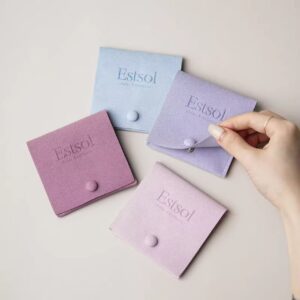
A jewelry pouch may look simple, but it is in fact the last physical touchpoint between a brand and its customer — and the beginning of the first “private conversation.” This article examines the professional logic behind jewelry pouches across three dimensions: materials, compliance, and experience.
Material Selection: More Than an Aesthetic Question
The global jewelry pouch market is segmented by material into velvet, satin, organza, cotton, and other categories. Each material sends a fundamentally different brand signal: velvet and satin convey classic luxury, while cotton and linen lean toward a more natural, sustainable brand identity.
But material choice goes far beyond “how it looks.” From a procurement perspective, several technical parameters are frequently underestimated:
Anti-tarnish performance. Silver and karat gold are sensitive to sulfides and moisture in the air. If satin or velvet pouches are not treated with anti-tarnish protection, long-term storage can accelerate surface discoloration of metals. Professional suppliers incorporate anti-corrosion agents into lining materials — something that should be explicitly written into specifications during bulk purchasing.
Consistency in stitching. By industry standards, premium jewelry pouches should maintain a stitch density of 7–9 stitches per inch, with even stitching and no skipped stitches. Edge binding should be held within 1mm, with no cracking at curved sections. These details directly affect both durability and “hand-feel weight” — the moment a customer touches the pouch, they are already subconsciously scoring the brand.
Printing and logo techniques. Screen printing and digital printing are the mainstream options, but high-end brands increasingly turn to hot stamping and embossing. These techniques carry higher defect rates, so buyers should confirm the supplier’s QC standards and how losses are allocated.
Compliance Risk: A Procurement Threshold You Can’t Avoid in 2026
If your products target European or North American markets, compliance requirements for jewelry pouches are tightening rapidly.
The EU’s REACH regulation is updating its SVHC (Substances of Very High Concern) list at an accelerating pace. In 2026, limits on heavy metals such as cadmium and lead are extremely strict, with particular attention to plasticizer categories. The North American market is bound by California Proposition 65, which imposes strict warning label requirements for specific chemical substances — failure to label can result in substantial litigation.
In practice, a common problem is that “eco-friendly claims” lack verifiability. Some suppliers claim to use “biodegradable materials” but cannot provide SGS or RoHS test report numbers. For bulk procurement, we recommend stipulating in contracts that each batch must be accompanied by test reports aligned with the latest standards for the destination market — otherwise full return and replacement, plus liability for associated losses.
Another easily overlooked compliance dimension is the EU’s Packaging and Packaging Waste Regulation (PPWR) requirement for packaging reduction. By 2030, packaging weight and volume must be reduced to the minimum necessary for functionality. This means jewelry pouch dimensions need to match products more precisely, rather than relying on “one-size-fits-all” generic specifications.
Experience Design: From “a Bag to Hold Things” to a Brand Medium
In the e-commerce era, the unboxing experience has become a scarce window for brands to build emotional connection with consumers. The role of the jewelry pouch in this scenario is being redefined.
Balancing size and ritual. An oversized pouch makes the product feel insubstantial; an undersized one compromises the retrieval experience. The professional approach is to match pouch types to individual product SKUs — rings and necklaces have completely different retrieval patterns, requiring different opening/closing designs and interior spatial requirements. For chain jewelry, reducing “freedom of movement” inside the pouch is key to preventing tangling; for rings, ensuring the main stone doesn’t press directly against the pouch surface is essential.
Extending from protection to connection. A clear trend in 2026 is that jewelry pouches are evolving from purely “protective containers” into entry points for brand digital touchpoints. Adding a card with NFC or a QR code inside the pouch can guide users to product traceability, care guides, or membership benefits. According to industry feedback, smart interactive packaging has driven an average increase of over 40% in secondary customer engagement.
Sustainability as brand language. More than 70% of consumers say they are willing to pay a premium for brands that adopt eco-friendly packaging. But “eco-friendly” shouldn’t remain a slogan. Using FSC-certified paper, soy-based ink printing, or novel bio-based materials such as mycelium are all effective ways to communicate brand values at this jewelry pouch touchpoint.
Several Judgment Criteria in Procurement Practice
For brands currently evaluating jewelry pouch suppliers, the following questions can help quickly assess a supplier’s professionalism:
– Can you provide test report numbers from the most recent quarter covering REACH and Prop 65, with clear indication of which specific plasticizers are included?
– What is the open/close life-cycle test data for zippers or drawstrings? Are there aging test reports simulating humid environments?
– For bulk orders, can you guarantee that each carton includes an independent QC pass label and supports random inspection?
– For different SKUs, do you offer size-matching recommendations rather than simply providing standard specifications?
A jewelry pouch is a “small item,” but what it carries is the final layer of physical trust between a brand and its customer. Costs saved at this touchpoint are often repaid in another form — through return rates, brand perception, and repurchase intent.
Related Items


